
Quick Snapshot
“Can smart tile choices make a small room feel bigger? In many cases, yes. Large-format tiles are trending because they reduce grout lines, simplify sightlines, and help walls and floors read as more continuous surfaces. That does not change a room’s square footage, but it can make compact spaces feel calmer, cleaner, and less visually crowded.”
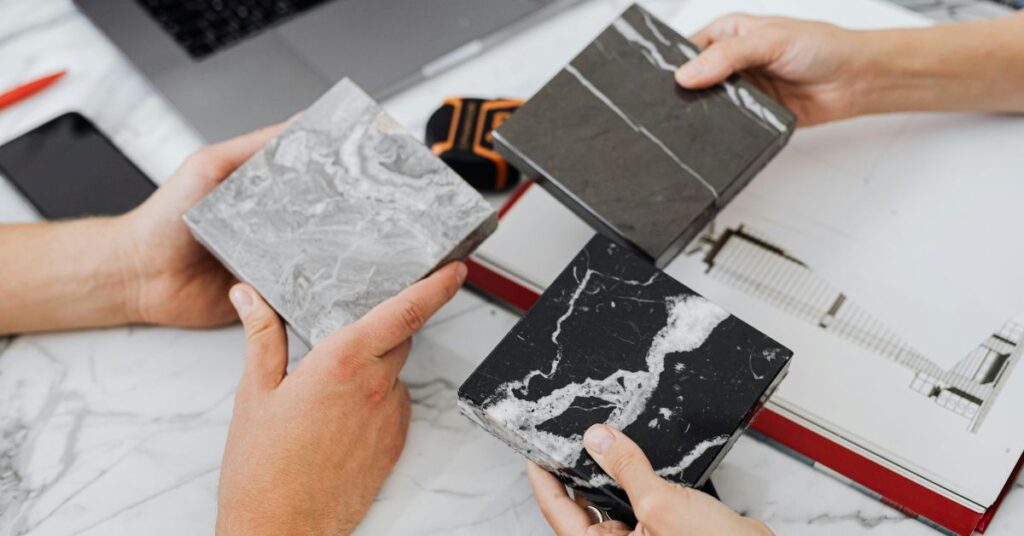
Small rooms are often treated as a limitation, but surface design plays a major role in how that limitation is perceived. In bathrooms, galley kitchens, laundry rooms, and narrow hallways, tile size can affect whether a room feels fragmented or visually settled. Large-format tile has become popular in these spaces because it reduces interruption across the surface and helps the room read more clearly.
That is the real appeal. The trend is not only about a modern look. It is about reducing the visual breaks that make small spaces feel tighter than they are. This is particularly important in kitchen tiles for backsplashes and floors, where a more uninterrupted surface can help a compact layout feel more unified and less visually crowded.
Why Large-Format Tile Works in Small Spaces
The main advantage of large-format tile is visual continuity. Smaller tiles create more grout joints, more pattern repetition, and more visible stops across a wall or floor. In a small room, those breaks can make the space feel busier and more confined. Larger tiles reduce that effect by allowing the eye to move across the surface with fewer interruptions.
This does not mean large-format tile automatically makes every small room look larger. The visual benefit depends on how the tile is used, how much cutting is required, and whether the overall layout supports a more continuous surface. But when the room geometry is fairly clean, the reduction in visible joints can make a noticeable difference.
There is also an important technical point behind this design choice. Tile standards have become more precise as larger formats have become more common. In current ANSI terminology, “Large Format Tile” has a specific definition, but for many residential projects, the more practical threshold is when any one edge is 15 inches or more, because stricter substrate flatness requirements begin there. ANSI’s current terminology defines Large Format Tile as tile with a facial dimension greater than 23 inches, while ANSI flatness requirements tighten for tiles with at least one edge 15 inches or longer.
That matters because the visual simplicity of large-format tile depends heavily on the quality of installation. A larger tile can reduce visual clutter, but it can also reveal substrate problems more easily.
Why the Trend Has Practical Value
Large-format tile is not popular only because it looks cleaner. It also has practical advantages when selected appropriately for the room.
Fewer grout joints usually mean fewer lines to maintain and fewer places for residue to collect. In bathrooms, laundry rooms, mudrooms, and kitchens, these can make a visible difference in day-to-day upkeep. The result is not maintenance-free, but a surface with fewer grout joints often looks less busy and is easier to keep orderly.
Material choice still matters. In wet or spill-prone areas, porcelain is often the stronger option because it is denser and more moisture-resistant than many standard ceramic products. Floor safety also needs to be judged separately from appearance. ANSI A326.3 is the current U.S. standard used to measure the dynamic coefficient of friction for hard-surface flooring, and TCNA notes that this standard includes product-use classifications and guidance for specifying flooring materials.
So the practical value of large-format tile is not simply that it reduces grout. It is that, in the right material and finish, it can support both a cleaner visual field and more manageable long-term use.
Where Large-Format Tile Has the Strongest Effect
Large-format tile tends to be most effective in small rooms where visual clutter builds quickly, and surface runs are relatively uninterrupted.
Small bathrooms are often the clearest example. On floors and wall surfaces, larger tile formats can make the room feel less visually fragmented by reducing the number of visible joint lines. The result is often strongest when the tile continues across more than one surface, such as from the bathroom floor to the shower wall or across a vanity wall.
Compact kitchens benefit differently. Here, large-format tile often works best when it supports visual order rather than scale alone. A simplified floor pattern can make a narrow layout feel less crowded, while a large-format backsplash can reduce seam lines and help the wall feel cleaner behind counters and cabinets.
Laundry rooms, mudrooms, and entry areas can also benefit because they often carry visual clutter from storage, appliances, or frequent use. A larger tile format can make these spaces feel more intentional and less pieced together.
When Large-Format Tile Can Visually Fail
Large-format tile does not always create a stronger visual result, especially when the room layout works against the format.
Large-format tile can fail to make a room feel bigger when:
– The room is highly irregular
– The layout creates many narrow perimeter cuts
– fixtures and penetrations break the surface too often
– The tile pattern is too bold for the room size
– The grout color strongly contrasts with the tile
– The scale of the tile feels forced rather than proportionate
– lippage or uneven joints draw attention to the installation
In those cases, the surface may still have fewer joints, but the room does not necessarily feel calmer. Instead, the eye may be pulled toward awkward cuts, strong contrast lines, or visible installation flaws. That is an important distinction. Large-format tile works best when the room allows the format to look deliberate, not imposed.
Wall Application and Floor Application Should Be Judged Differently
One reason large-format tile is often discussed too generally is that wall performance and floor performance are not identical.
On walls, the visual effect usually carries more weight. Large-format tile can work especially well here because walls are not subject to the same slip-resistance demands as floors. This makes it easier to use smoother or more reflective finishes that support the design.
On floors, the decision has to be more practical. Visual continuity still matters, but so do slip resistance, room shape, drain locations, substrate flatness, and traffic conditions. A tile that looks strong on a shower wall may not be the right choice for the bathroom floor. Likewise, a polished finish may increase reflectivity on a wall but be less suitable underfoot in a wet area.
This is why small-space tile planning should not ask only whether large-format tile looks better. It should ask whether the specific surface being tiled can support the format safely and cleanly.
How Orientation and Grout Affect Perception
Tile size is only part of the visual result. Orientation and grout color can either support or weaken the spacious effect.
In narrow rooms, the direction of installation can affect how the room is perceived. A rectangular tile laid lengthwise can emphasize the long run of a hallway or galley kitchen, while a crosswise layout can visually widen the room. Neither is universally correct. The better choice depends on which dimension needs visual support and where the dominant sightline begins.
Grout also matters more than many homeowners expect. If the grout closely matches the tile color, the surface tends to read more continuously. If the grout contrasts sharply, it can recreate a visible grid even with large-format tile. In that situation, the room may still feel segmented despite using fewer pieces.
So when the goal is to make a small room feel more expansive, tile size alone is not enough. The size, layout direction, and grout contrast need to work together.
Where Large-Format Tile May Not Be the Best Choice
Large-format tile is not automatically the best option for every compact room.
It may be a poor fit when:
– The room shape is highly irregular
– There are many corners, fixture penetrations, or interruptions
– The layout would leave too many small edge cuts
– The substrate needs substantial flattening
– The floor requires complex slope management, especially around drains
– Traction is a higher priority than visual continuity
This last point is especially important in wet areas. A polished tile may help with light reflection, but that does not make it the best choice for a bathroom floor. In those cases, product-specific DCOF information is more useful than general assumptions about finish categories.
How to Choose the Right Size for the Room
The best tile size is not the largest one available. It is the largest format the room can support without making the layout look strained.
A practical rule of thumb:
12×24 often works well in small bathrooms and secondary spaces because it reduces visual clutter while still fitting more easily around toilets, vanities, and tighter room geometry.
24×24 often suits square or nearly square rooms where a more balanced grid is possible and perimeter cuts can remain controlled.
24×48 is most effective where there are cleaner sightlines and enough uninterrupted surface area to justify the scale. It can be very effective on larger bathroom walls, open floor runs, or statement surfaces, but it demands stronger layout planning and a flatter substrate.
In many small rooms, a well-planned 12×24 tile will perform better than an oversized tile that technically fits but creates difficult cuts and visual tension around the perimeter.
Porcelain vs. Ceramic in Small Bathrooms
For many bathroom applications, porcelain is often the safer default.
That does not mean ceramic is unsuitable. Ceramic can still work well on walls and in some light-duty areas. But on bathroom floors and other moisture-prone surfaces, porcelain is often preferred because it is denser and generally more water-resistant. That makes it a more reliable choice in spaces exposed to humidity, splash conditions, and regular wear.
For homeowners, the more useful question is often not simply whether to use large-format tile, but whether the application calls for large-format porcelain rather than a standard ceramic alternative.
Matte vs. Polished in Wet Areas
Finish should be selected according to use, not appearance alone.
Matte or textured finishes are usually the safer choice for bathroom floors, entry areas, and utility spaces because they tend to be more forgiving under wet conditions and everyday use.
Polished finishes can work well on walls or lower-risk surfaces where reflectivity is part of the design goal. In a small room, they may help distribute light more effectively, but that visual benefit should be weighed against maintenance and slip considerations.
In wet-floor areas, the most useful reference is the actual product specification rather than general assumptions about what “matte” or “polished“ usually means. TCNA’s DCOF guidance exists for that reason.
Installation Is What Determines Whether the Design Succeeds
Large-format tile only delivers a clean result when the installation standard supports it.
Bigger pieces do not hide an uneven surface. They often make irregularities easier to notice. TCNA notes that lippage is the difference in elevation between adjacent tile edges and that lighting, reflectivity, tile warpage, joint spacing, and substrate variation all affect how visible it becomes.
This has direct planning implications. For tiles with at least one edge 15 inches or longer, ANSI flatness requirements tighten to no more than 1/8 inch variation in 10 feet and no more than 1/16 inch in 24 inches.
That means large-format tile may reduce grout joints but increase installation demands. It can require more substrate preparation, more careful handling, tighter layout planning, and a higher level of installer skill. In some rooms, that translates into more labor and a smaller margin for error.
Common Mistakes to Avoid
Several mistakes repeatedly weaken the result:
– choosing tile size based only on trend rather than room geometry
– ignoring perimeter cuts and interruptions around fixtures
– using highly contrasting grout when the goal is visual continuity
– selecting polished tile for floors without checking slip suitability
– assuming a larger tile will hide an uneven substrate
– underestimating the complexity of shower floors and drain areas
– hiring an installer without confirming large-format experience
Large-format tile may look visually simple, but the planning behind it is not.
Questions to Ask Before Hiring an Installer
Before hiring an installer, homeowners should ask a few practical questions about layout, preparation, safety, and cost.
Before installation, a homeowner should ask:
– Have you installed this tile size before in rooms this small?
– Will the substrate need flattening before the tile goes down?
– What layout will reduce narrow perimeter cuts?
– Should the wall and floor use the same format, or be judged differently?
– Is this finish appropriate for a wet floor?
– Are you recommending porcelain or ceramic for this application, and why?
– How will you handle slope and cuts around drains or fixtures?
– Would grout color contrast make the room feel more segmented?
– Which tile direction will best support the room’s shape?
– What parts of the cost relate to tile, prep work, labor, and waste?
These questions move the decision away from appearance alone and toward performance, safety, layout quality, and long-term value.
Final Assessment
Large-format tile is trending in small-space design because it addresses a real visual problem: compact rooms often feel more crowded when surfaces are broken into too many visible units. Larger formats can reduce that fragmentation and help a room read more clearly. But the result depends on more than tile size alone.
Room geometry, tile orientation, grout contrast, material choice, slip resistance, substrate preparation, and installer skill all influence whether the format improves the space or creates new problems. That is why large-format tile is not simply a style preference. It is a planning decision.
Used carefully, it can make a small room feel more settled, less visually interrupted, and easier to maintain. Used poorly, it can create awkward cuts, safety concerns, visible lippage, and a result that feels forced rather than spacious. That balance is what readers need in order to make an informed choice.